Thursday, January 19, 2023

What makes a good investor?

I recently penned my 2022 year end investment letter and discussed some traits that have made us successful over the last 15 years. We don't have all the answers and no one does, but sticking to our niche and focusing on risk management has kept us in business and able to offer an above average return with less risk to our clients. Below is some of the letter and touches on some themes that have contributed to our success.

While WCP was down slightly in 2022, we protected most of our gains from the previous bull market and stand ready to deploy capital when conditions become favorable for our investment style. Investing capital is not about knowing things or predicting the future. Clearly Wall Street analysts are not good at making predictions. Every single brokerage house predicted the S&P 500 would be higher in 2022. To be honest, more information is always better than less. However, to be successful you don’t need to know everything about monetary and fiscal policy, economic indicators, earnings estimates, statistical analysis, etc. Rather, a good trader needs to accept the unknowns and embrace our fallibility while exploiting the edge that tilts the odds in our favor. The foundation of our edge relies on our ability to reduce exposure during bear markets through our relentless pursuit of risk management above all else. We don’t weld ourselves to a specific opinion or prediction. Instead, we sift through all the data to produce a thesis and use price action to confirm our bias. And when the facts change or the tape isn’t confirming our direction we are quick to cut our losses and reassess our positioning. We remain humble and know it’s not always the most intellectual that survives a bear market but rather the portfolio manager that is best able to adapt and adjust to changing market environments.

2022 was a trying year for investors as almost every asset class lost ground. In a rare occurrence both stocks and bonds fell in unison as the Fed turned from investors’ best friend to the largest headwind. A 60/40 portfolio mix consisting of S&P 500 and US Aggregate Bond Index returned -16%. That was the second worst year on record since 1976. It was a year about survival and keeping losses to a minimum. We never like drawing down some profits from previous years but what made our small loss last year more impressive was the returns of risk assets that comprise our investable universe. It was an extremely difficult year in the growth sector which typically makes up our long exposure. On top of that, every speculative asset class got hit hard from growth stocks to cryptocurrencies to IPOs. For example, Tesla, which had been the source of alpha over the last few years fell over 65% for the year. To put in perspective how challenging the environment was for growth investors, look at the returns below for select growth assets.


Our key to success was attributed to our flexibility as we were very early to reduce risk exposure when our market indicator flashed a sell signal during the beginning of this bear market.  We stayed very light on capital allocations as opportunities have been limited on the long side. A continuation of our edge is knowing when our strategy is not performing versus when to press the accelerator and go for big wins. As the environment changed from easy money to a more difficult tape, we avoided most of the carnage during the bear market by staying nimble, keeping risk under control with low exposure, and remaining disciplined. During challenging times, it is best to avoid landmines, keep powder dry, and live to fight another day. As we weather the storm, we don’t plan on rushing things but once the narrative changes and opportunities present themselves, we’re in a great position to exploit the upside.

These are not easy times for investors as there are plenty of headwinds to deal with that could make 2023 another tough year. While bear markets are painful to endure, they are healthy and give the market a chance to reset. However, I try not to get sidetracked by splashy headlines, macro news, and noise in general. We are very excited about the path forward due to the technological revolution. In 2023 and beyond, we anticipate the largest technological breakthroughs with regards to some of the major obstacles we face as a country. Themes that are currently emerging to solve our most pressing issues are: artificial intelligence, clean energy, automation, obesity, cure for various types of cancer, and rare disease therapies. We remain optimistic, as it is an exciting time to be a part of the investor class. Our game plan is to remain cautious and flexible as market conditions evolve. We are like a big wave surfer in that it’s never clear just when and where the next big one is going to surface. When we identify the next monster wave, we’ll be prepared to pounce on the break, ultimately providing life-changing opportunities going forward. 

I hope you enjoyed and after a difficult 2022 we are excited for what 2023 will bring!

Tuesday, November 8, 2022

Markets, elections, and money flows

Today voters across the country go into the booth to cast their ballots for the midterm elections. We have a ton on statistical data on the markets during such events. Will the outcome change the direction of markets? We really don't know the answer but I would think based on betting odds it looks like we'll have a divided government. Below are the current odds for the house and senate from electionbettingodds.com.


A divided government is favorable for  market returns and could be one of the reasons for the recent rally off the lows. Below shows the market returns under different leadership since 1977. 


On top of that we are in a seasonably favorable time for market returns. Below is a study from Wayne Whaley. Since 1950 the S&P has never closed lower from the November of a midterm election year through April of a pre-election year while averaging 15% returns. 

Ryan Detrick shows a similar outcome but also how weak markets tend to behave heading into a mid-term election. "The average midterm year since 1950 corrected 17.1% on average, the most out of the four-year presidential cycle. That’s the bad news, the good news is stocks gained 32.3% on average a year off those lows and have never been lower. Although we don’t know if October 12 is officially the low or not (but we think it very well could be), there could be a lot of opportunity for bulls over the coming year."


The statistical data certainly favors the bulls. However, what has us most concerned are the fundamentals and money flows. We have yet to see see numbers drastically cut or a panic in sentiment. The VIX continues to languish showing no real fear. 

Prior market bottoms coincided with a capitulation in equity flows. We are not there yet. 


As of the end of October the average consensus among wall street analyst is for S&P earnings to grow 7.3% in 2023. However, some analyst are starting to cut their estimates as Goldman just did citing margin headwinds next year. BofA says S&P 500 earnings estimates for 2023 take complete U-turn as recession risks loom. What if we get a recession in 2023 and current estimates are way too high. Below is how much S&P earnings have retreated in each of the prior 11 US recessions. 

If current 2023 estimates are $233 for S&P 500 what happens if they are drastically cut. Below are some scenarios depending on the magnitude of decline in 2023. With current year estimates now around $220 for 2022:

Decline          EPS estimate

5%                 $209

10%               $198

15%               $187

20%               $176

The forward 12-month P/E ratio for the S&P 500 is 16.1. This P/E ratio is below the 5-year average
(18.5) and below the 10-year average (17.1). If the S&P trades on a 10-year average for 17.1 times next year earnings based on lowered guidance where does that put the market?


Lastly, we continue to like the historical analog Jurrien Timmer at Fidelity has shown with the similarities to the 1946-49 market. "Then, as now, stock prices reflected the impact and then hangover of major fiscal/monetary impulse. If the analog holds, we could be in the process of another 15% counter-trend rally followed by another retest of lows."

Once again there is something for both the bulls and bears. We try not to get too invested in one side or another and rather react to market trends and conditions. Our best guess is the next few months won't be an easy one either way with lots of confusion and choppy/volatile markets. The 1946-1949 analog would really frustrate the masses. Will be watching inflation data, rates, and the US dollar for any clues as these have been the driver of market returns the last year or so.


Wednesday, August 17, 2022

Is the bear market over?

We would love to know the answer to this question also. Unfortunately, we won't ultimately know until hindsight sets in. How do we try and decide in real time though? The best course of action is to look at what the current data tells us and try to put the probabilities in our favor. Has the character of the market changed and is there evidence that the bear is behind us? Nothing is certain in trading, but to create an edge we need to put the odds on our side. Lets get into it.

Below is a list of all bear market rallies from Milton Berg since 1973. Just one bear market both lasted longer than 37 days and gained more than +14.82%.

For the first time since the Nasdaq topped late last year, the MACD has turned positive during the current rally. 


Based on 12 studies on market breadth done by Chris Ciovacco in his weekly market update, the odds are heavily in favor of the bottom being put in. Based on 61 signals over 12 studies, the low was made in 93.4% of cases. Which means there is a 6.6% chance the market can still make a lower low. 

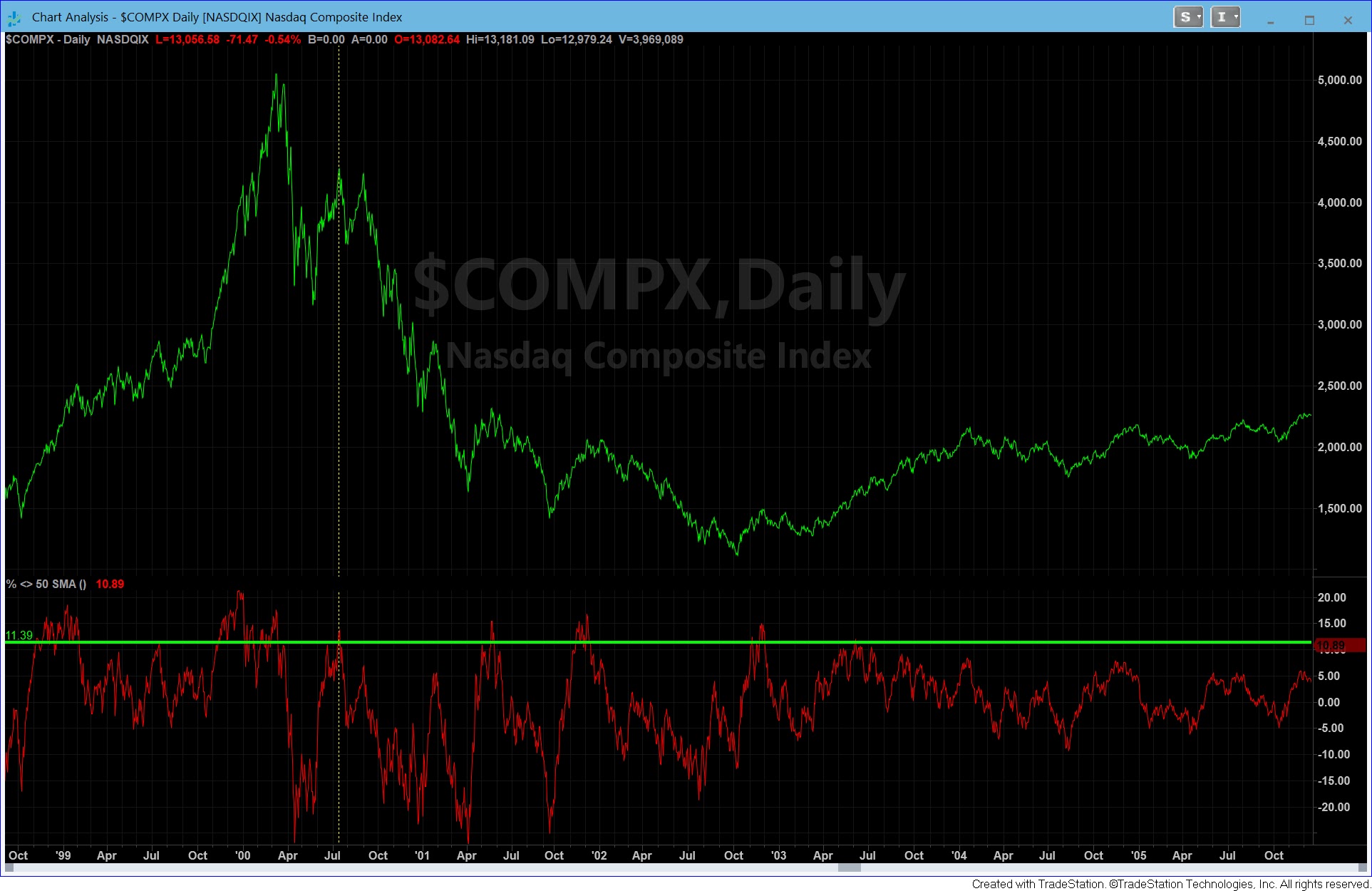
Below is a daily chart of the Nasdaq with the percentage of extension above or below the 50 day. We recently hit levels only hit 3 other times in the last 20 years. 2 out of 3 ended a prior bear market. The 2000 rally was a bear market rally that eventually rolled over.


Another measure of breadth thrust from Jonathan Harrier is favorable to the bulls over the next 12 months. 


Yet, this tweet thread from Jurrien Timmer explains why it is so hard to spot the difference between a bull market and a bear-market rally. If we look at data going back to early 1900s, breadth advances are associated with new bull markets and bear market rallies.  

Breadth readings during new bull markets:

Bear market rallies:


The current rally in the S&P has retraced 50% of its losses from peak to trough. As Jurrien states, "So, on a historical basis, if this rally advances much further, it will be hard to conclude that this is not a new bull market. This is one of the few technical clues out there. If this is a bear-market rally, it likely has gone as far as it will go."

Below is a chart from Ned Davis comparing bear markets depending on whether or not a recession occurred. 

One way we gauge sentiment is the monthly BofA fund manager survey. Below are the key takeaways from the most recent month.


  Cash still remains elevated showing the wall of worry traders still have. 


From a contrarian perspective the % of investors that think the global economy will experience a recession in the next 12 months is the highest since May 2020. The prior peaks were good buying opportunities. 

If we avoid an earnings-led recession but continue to have a valuation reset the outcomes are very different. This is the price analog from Jurrien Timmer that was discussed in our last blog and remains an interesting guide post. 

The evidence favors a market that has bottomed and will continue to climb the wall of worry and rally higher. The wild card remains if we get a bigger and nastier recession and this is nothing more than an extended bear market rally within the context of a longer bear market. A third scenario remains, in which the market has bottomed but finds itself trend-less for an extended period before resuming higher. Even with all the data presented it still remains difficult calling this a new bull market or a bear market rally. At the end of the day we really won't know until it's over what type of bear market this will end up being. What matters most is the price action and right now it favors a strong rally. When the evidence and facts change we will adjust accordingly.