Showing posts with label Monthly Review. Show all posts

Tuesday, December 10, 2019

Rounding out a decade

2019 is shaping up to be one of the best years for asset class returns.  It is a mirror image of last year in which every asset class except cash posted a negative return.  We have talked a lot about how strength begets strength and that has proven consistent all year long.   As we enter the final few weeks of the trading year there is no shortage of bulls and bears as we turn the clock on a new decade.

We remain in a favorably bullish period for the markets (Nov-April) and December is one of the best months of the year with a 1.50% average gain while finishing higher almost 74% of the time.

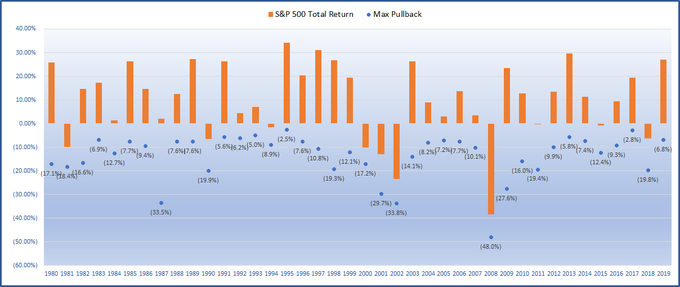
Not only has 2019 been a great year for the equity markets it has also been one of the least volatile.  According to Ryan Detrick, "the S&P 500 has pulled back 6.8% from peak to trough in 2019. This is actually one of the smallest pullbacks we've seen in recent memory."
Image 

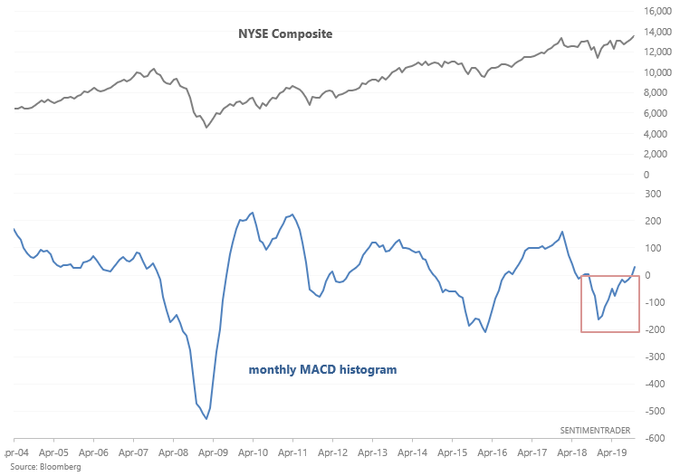
A great study from Sentiment trader trader shows the MACD indicator setting up bullish for stocks the next year.  Monthly MACD's are now turning positive for the Dow and NYSE Composite for the first time in >1 year. This is bullish for stocks on a longer term basis. When this happened in the past to the NYSE Composite, stocks went up 100% of the time 6-12 months later.
Image

As we embark on a new decade we also enter the 4th year of the presidential cycle.  Nautilus Cap does great cycle work and below shows the S&P seasonal composite for the forth year of the election cycle which shows first half volatility follow by a resumption of the trend and strong close to the year. 

Image 

On thing that has been missing from this market is complete market participation.  As equity indices hit new highs the amount of stocks hitting 52 week-highs is non existent.  In fact, more stocks are hitting new 52-week lows.  Meanwhile the A/D line supports the trend which is encouraging.  This all amounts to mixed signals from participation.  We can see from the chart below the A/D line in yellow is confirming the strength in the NYSE Composite while new highs total just 19 and are strongly outnumbered by 106 new lows.


If breadth is to confirm the strength in equity market it will need participation from small caps.  They have trailed the larger cap indices all year but are starting to gain traction.  Even though the Russell 2k remains below all-time highs posted in 2018 it did make a new 52-week high recently.  If you are buying small caps you are making a bullish bet on domestic growth in 2020.  If the economy avoids a recession, which we think is likely, and the economy accelerates, small caps will be a good bet.  Economic recoveries “tend to be the best phase for small-caps,” says Jill Carey Hall, an equity and quant strategist at Bank of America Merrill Lynch. “That’s one key reason we think we could be poised for a shift from large to small.” Small-cap outperformance is one of Bank of America’s biggest bullish predictions for 2020, strategists there said this past week.


When it comes to the economy, there is plenty of supporting data for growth to resume in 2020.  There has been no earnings growth this year.  According to FactSet, Q1 earnings were down 0.2%, Q2 earnings were down 0.4%, and Q3 earnings were down 2.2%.  In fact, it will market the first time in 3 years of three straight quarters of year over year earnings declines since Q4 2015 through Q2 2016.  Yet, equities are trading at all time highs.  Why is that?  Typically, equity prices are forward looking.  The most recent jobs report just printed an unemployment rate of  3.5% which is a 50-year low coupled with a surge in jobs.  With an accommodative Fed keeping interest rates low along with the good news for the US labor market in the November employment report could help validate the acceleration in the economy and earnings picture in 2020.  


Something to keep an eye on and one the bears will point to is valuations.  The US is one of the most expensive markets in the world based on P/E ratios.  Alex Barrow from Macro Ops highlighted this in his recent weekly update.  "Looking further out though into 2020 the SPX is going to be fighting some decently strong headwinds in the form of stretched valuations absent a visible driver of earnings growth. The below chart from Goldman Sachs shows the year-to-date rally has been almost entirely driven by valuations rerating higher. Over the longer-term, this is unsustainable — especially in the US where valuations are already high. Either earnings growth will need to pick up materially or equities will hit a wall."


These lofty valuations has Morgan Stanley lowering expectations for the next decade.  Morgan Stanley expects the opposite for the next 10 years, as it sees valuations and returns reverting to their means. Translated, today’s high stock prices point to low future equity returns. Low bond yields necessarily mean lesser fixed-income returns. Moreover, taking on bigger risks also isn’t likely to pay off in bigger returns, the investment firm adds. “We estimate the average 60%/40% stock/bond portfolio will return only 4% to 5%, roughly half that of the past decade,” writes Lisa Shalett, chief investment officer at Morgan Stanley Wealth Management, in a client note.

As markets embark on new highs, lets check in on sentiment.  Considering the recent strength from the October lows we would expect to see overheated levels.  The CNN fear and greed index is flashing greed but is not overly excessive. 


More supporting evidence that we could get a year end rally is the NAAIM Exposure Index which represents the average exposure to US Equity markets reported by active managers.  It is elevated but still well below 2019 highs as markets sit at yearly highs. 


In summary, if earnings and economic growth accelerates in 2020 higher valuations can be justified with the low interest rate envrionment.  However, if said growth doesn't materialize the markets could be in for a volatile ride considering what they seem to be pricing in. 


Monday, September 30, 2019

Ocotber and the 4th quarter

As we head into the 4th quarter we wanted to look at the potential for the year end.  Historically, October has been associated with volatility.  In fact, since 1950 October ranks as the most volatile month with the highest draw down and draw up of any month.  From a return perspective, October ranks in the middle of the pack.


When we look at the daily trend for October it starts slow but finishes strong.  Below is the average daily trend for October for the last 20 years.  


In prior posts we have talked about how a strong start to the year typically is followed by strength till year-end.  However, a tweet by Ryan Detrick shows how the next few months could be choppy. 

Just wanted to highlight the potential for an increase in volatility as we head into the 4th quarter. 

Tuesday, July 2, 2019

New Highs - Now What?

It has been a volatile few months with the markets straight down in May only to rally in a V-shaped manner in June.  The S&P 500 is back testing new highs as this is the third test of highs going back to September 2018.  So far the last few months have played out nothing like the historical average.  Going back to 1950, the average May shows a gain while June shows a loss.  July remains one of the stronger months while August is the second weakest month.  How with the rest of the summer play out? 


One primary concern of many investors is the lagging performance of small caps.  It is last index not at or close to new highs. It remains well below the September 2018 high.  See the bottom right chart.


However, the Russell 2000 underperformance should not be a primary concern according to a study from Mark Hulbert.

Another great post from Urban Carmel at the Fat Pitch Blog highlights why investors should be more worried when small caps lead.  "By contrast, small caps are lagging. They have retained none of their gains made over the past 1-1/2 years and haven't been close to a new ATH in 10 months. Should investors be worried?  By most measures, the answer is probably not. Small cap underperformance has more often marked a low in SPX, not a high. Investors should be more worried when small caps - which are highly speculative and high beta - lead, as this has most often been a feature of major bull market tops, the reverse of the situation we have now."

One of the measures we follow to get a general sense of participation is breadth.  There remains some conflicting signs.  While the cumulative A/D line is advancing to new highs with the S&P, there are a number of other contradicting breadth measures. 


The percentage of S&P stocks trading above their 50 day moving average peaked in the first quarter and has yet to take out new highs along with the market. 


The number of stocks making 52 week highs on the S&P peaked June 7th during the start of the current rally.  It has made lower highs as the S&P is making higher highs. 


Another indicator we track and follow is a measure of overbought/oversold conditions.  We track the amount of stocks up 50% in a month.  This gives us a good idea of when a market gets excessive.  As with all indicators you have to take them in context.  Overbought signals at the beginning of a trend can be viewed positively.  However, if you get them after an extended run they can signal exhaustion. If we study the table below it gives a few clues.  We looked at every instance since 2010 when the indicator first reached overbought levels.  We removed the clusters.  The returns are weaker against the whole sample in all four time frames.  Going out 10 and 20 days is the biggest divergence in returns. 


As we remain in the challenging 6 month stretch of May through October we look to secondary indicators to confirm the trends.  The trend remains up and bullish as most indices are at or close to new highs.  Small cap underperformance shouldn't be viewed as big as a negative as the pundits make it out.  The A/D line is a broad measure confirming the trend.  However, for the markets to sustain and ultimately blow through new highs on the upside we'll need to see the secondary indicators participate. 

Have a great 4th of July!


Friday, March 1, 2019

A look to March and beyond

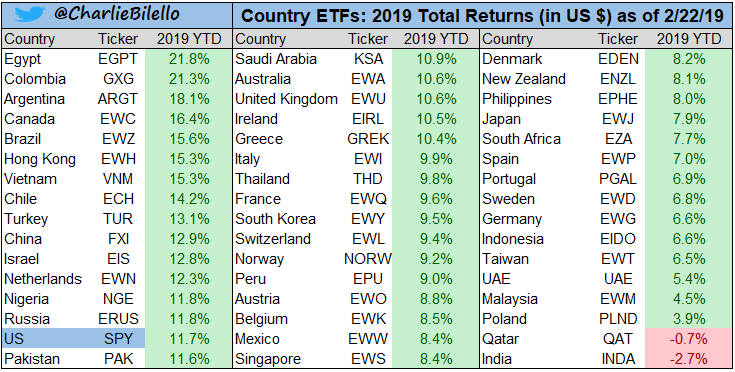
The global markets have started off 2019 on a blistering start with the average return of +10%. According to Charlie Bilello, global equities are off to their best start to a year since 1987: 46 out of 48 country ETFs positive w/ an average return of +10%.  Domestic markets have been extremely strong after a tough 2018 with small caps and tech weighted indices leading the charge.  We have gone from a risk off 3-month bear market to a V-shaped risk on environment.  The Russell 2k fell 12 out 16 weeks while the NDX fell 9 out of 12 weeks from their fall peaks.  Since their December trough, both the RUT and NDX have rallied 9 weeks in a row.  Can they extend the streak to 10 weeks?  During the same stretch the VIX has gone from over 35 to below 15.  Needless to say, its been a volatile 6 months since the September 2018 highs.  How does the current strength position us for the rest of the year?


The statistical analysis sets up very favorably for sizable gains the rest of the year based on the current strength YTD.  Below are various studies that validate strength begets strength.  As much as we use data and statistical analysis to shape our bias and views we have to remember that the predictive nature of data is just one tool that we use to guide our thesis.  Last year was a great example of how useless this data can be and a good reason why we don't follow it blindly.

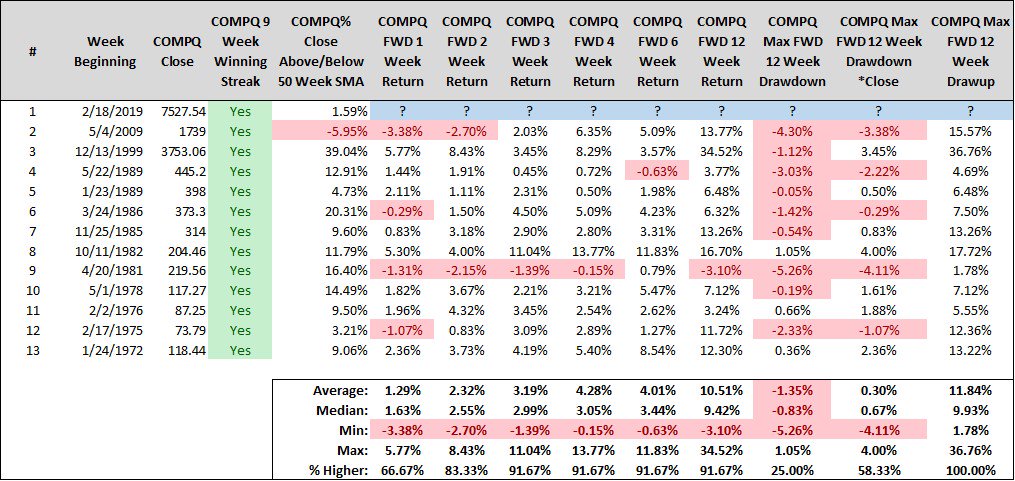
Steve Deppe has a nice table showing what happens after the Nasdaq has gained 9 weeks in a row.  If returns 3 months from now meet the historical average (10.5%), Nasdaq will be well above its September all time high. 


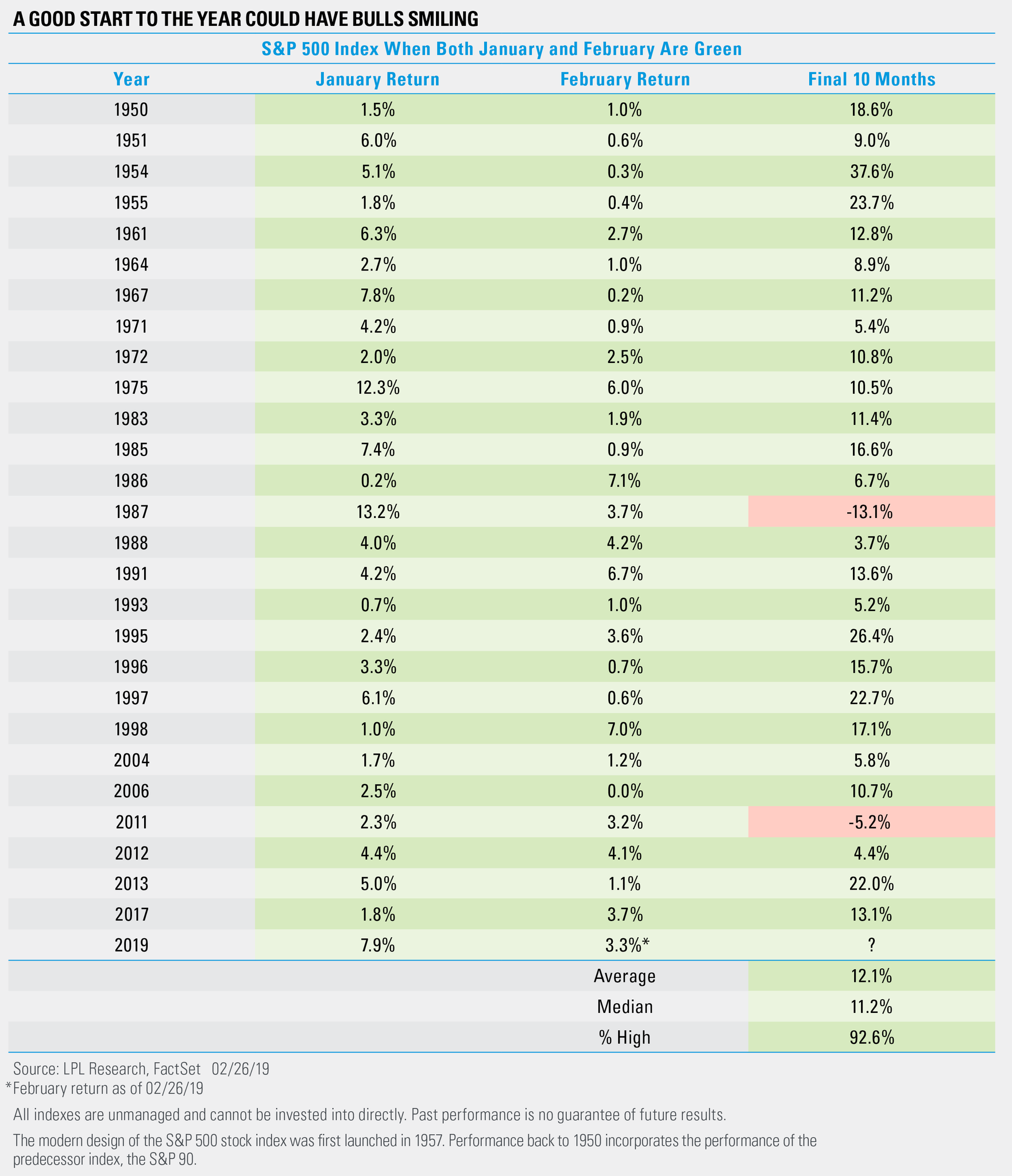
A post from Ryan Detrick shows the past 27 times the S&P 500 was higher in both January and February saw the final 10 months gain 25 times. Additionally, the avg return is 12.1% versus an avg final 10 mos of 7.6.


According to Nautilus Capital when the S&P is up 7.5% or more through February, gains continue to be promising going forward. 


An interesting stat from Bespoke speaks to the strength of the winning streak to start the year.


Are you tired of winning yet? Based on the S&P 500's start to 2019, the odds are that if you aren't tired of winning now, you will never be.  With the S&P 500 on pace for its 27th up day in the 37 trading days so far this year, 2019 is on a record pace for the frequency of positive days to start a year. Throughout the history of the S&P, there has never been a year that saw so many positive days in the first 37 days of trading (73%), and there have only been seven other years where the percentage of positive days even topped two-thirds at this point in the year. For reference, in an 'average' year it typically takes until March 16th before the S&P 500 has its 27th positive close of the year,and the longest it ever took for the S&P to reach its 27th positive close of the year was in 1932 when the 27th up day wasn't until April 21st.

The morning track from Raymond James chief strategist Jeff Saut had some good commentary from Leoy Tuey.  "Word of wisdom from Leon Tuey as many brokers continue to look for a test of the low.  While short-term overbought, a pause is all the bears can expect, but no major setback because:

1. In December, investors panicked and sold down to "sleep level" and beyond. Consequently, they are grossly under-invested inequities and are sitting on record cash.
2. While short-term optimism has risen, sentiment backdrop remains one of fear, not pessimism, but fear.
3. More importantly is global easing. Because of global slowing, the EU, Japan, and the U.S. are becoming more dovish. As mentioned in my reports, last year, Jerome Powell, the Fed Chairman, made a profound announcement that few paid attention: "We would like to smooth out the wild swings in past economic cycles by fine-tuning the monetary policy." If successful, the US and the world will see a period of unparalleled prosperity as history shows that the best environment for equities is in a period of modest growth and stable inflation, not too hot, not too cold, the so-called Goldilocks economy.
4. The record highs set by the Advance-Decline Lines speaks to the strength and power of this bull market. Will they test the lows, not bloody likely!"


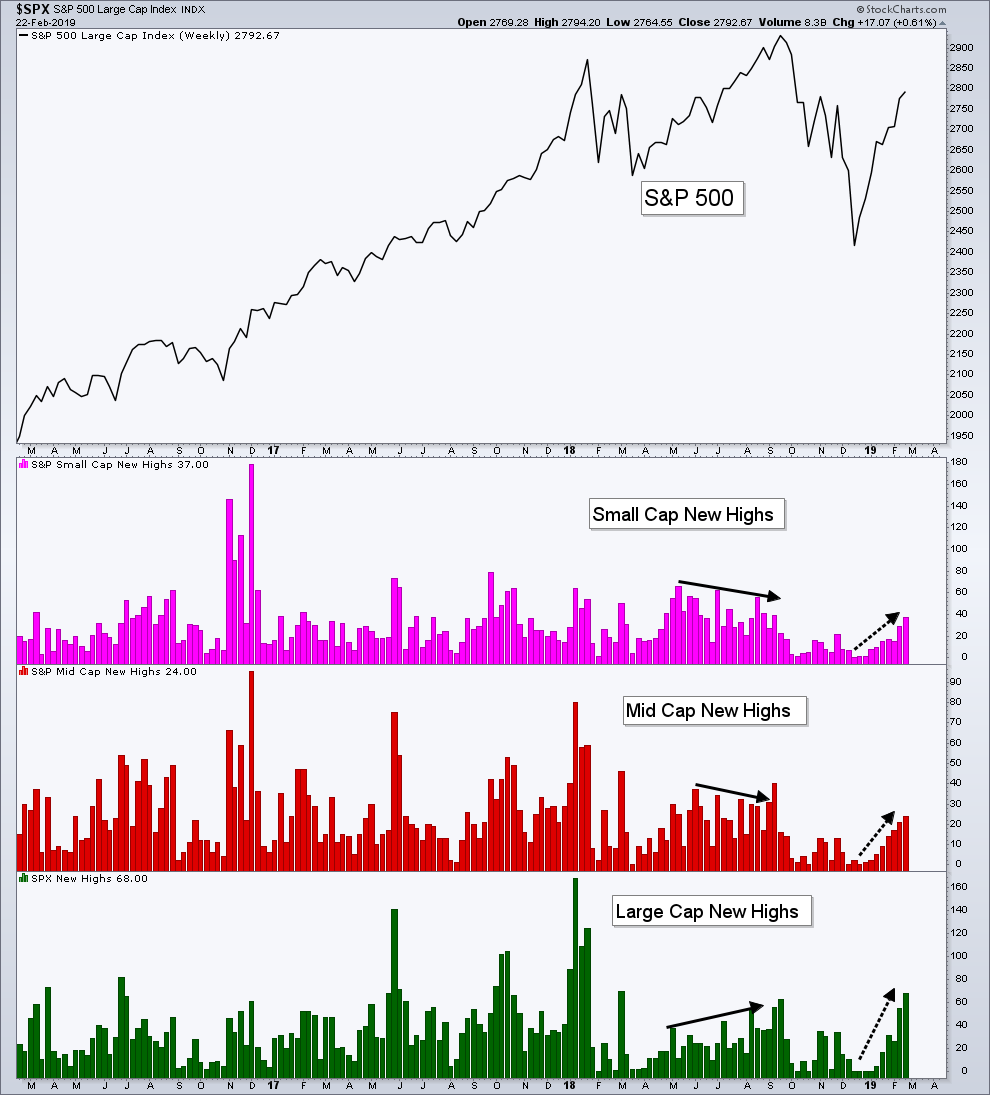
Breadth has confirmed and added to the bullish theme to start the year.  An expansion of new 52-week highs along with the % of stocks trading above their 50 and 200 day moving averages continues to increase. 


While I remain concerned about the volatility landscape, it is encouraging to see new 52-week highs continue to increase across small-, mid-, & large-caps - a luxury we didn't enjoy going into the September high.


The % of stocks trading about their 50 day moving average is higher then the Jan and Sept 2018 peaks. 


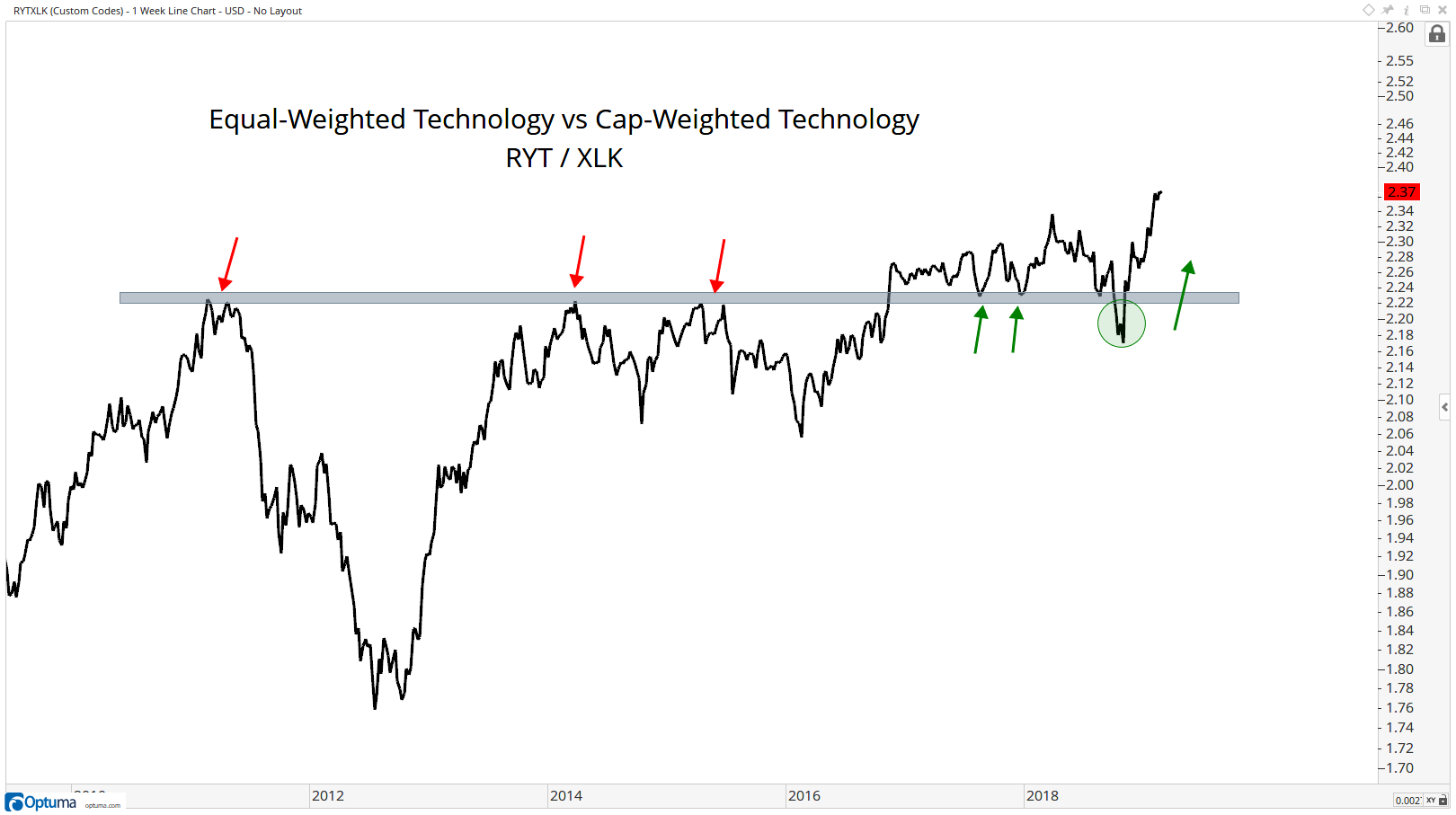
The S&P on an equal-weight basis has led the move higher and taken out the November and December highs before the cap-weighted index.  This suggest broad participation and expansion of breadth.  Meanwhile the equal-weighted tech index is outperforming the cap-weighted tech index.  The FAANG stocks have been a headwind for the cap weighted indices.  If they start to rally this move could really get into overdrive.


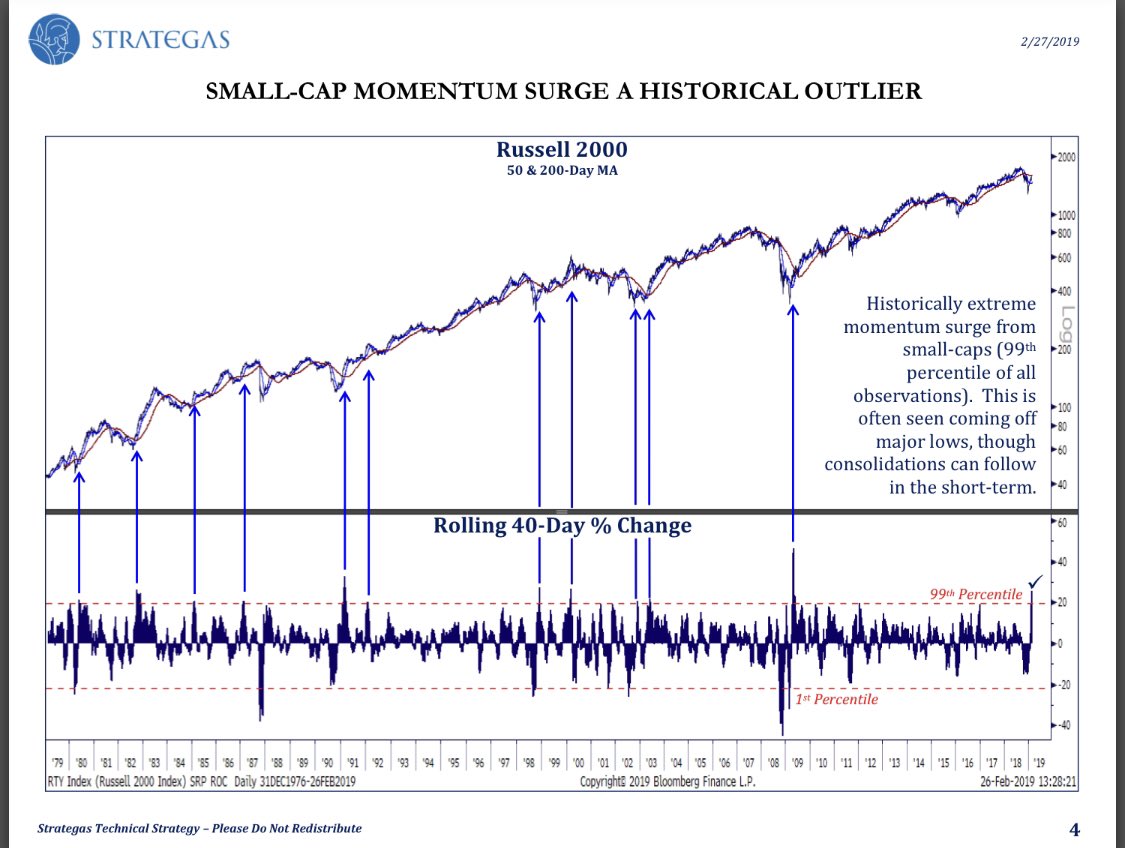
The rally to start 2019 has been nothing short of spectacular.  We remain oversold throughout the rally and their is some evidence that the indices could retrace some of the gains in the short term.  There is typically a period of consolidation after strong rallies. 


40 day % change for small-caps in 99th percentile! Historically rare - data says pause in near term, but better than average returns +6 months forward.


Urban Carmel at the fat pitch blog highlights a case from 1989. DJIA rose 9 weeks in a row and then went into a 10% trading range lasting the next 8 months. It eventually broke out of this range and made a new ATH another 8% higher. The lesson: a set up for a longer term continuation higher can sometimes take a frustrating long time to unfold.


We started this blog with a question about how the current strength positions us for the rest of the year.  In summary, the data suggests a favorable environment for continued gains throughout the year.  Breadth has been expansive, confirming the strong trend higher.  However, there is some evidence that a period of retracement or consolidation is a decent probability in the short term. 

Wednesday, August 1, 2018

August and Seaonality

As the S&P 500 embarks on a four month winning streak we wanted to look at how seasonality plays out the rest of the summer.  So far the market has enjoyed a nice summer rally with a healthy gain in July.  However, if we turn to August we can see the potential for some summer angst.

 Looking at August data:
  • Last 20 years: August ranks dead last in monthly performance with an average loss of 1.02%
  • Last 20 years: August has the highest average draw-down from the prior months close while the second lowest draw-up from prior months close
  • Last 20 years: The average daily trend starts weak and finishes at the lows
  • Last 20 years: August is the third most volatile month
  • Since 1950: August ranks second to last in monthly performance with an average loss of 0.09%


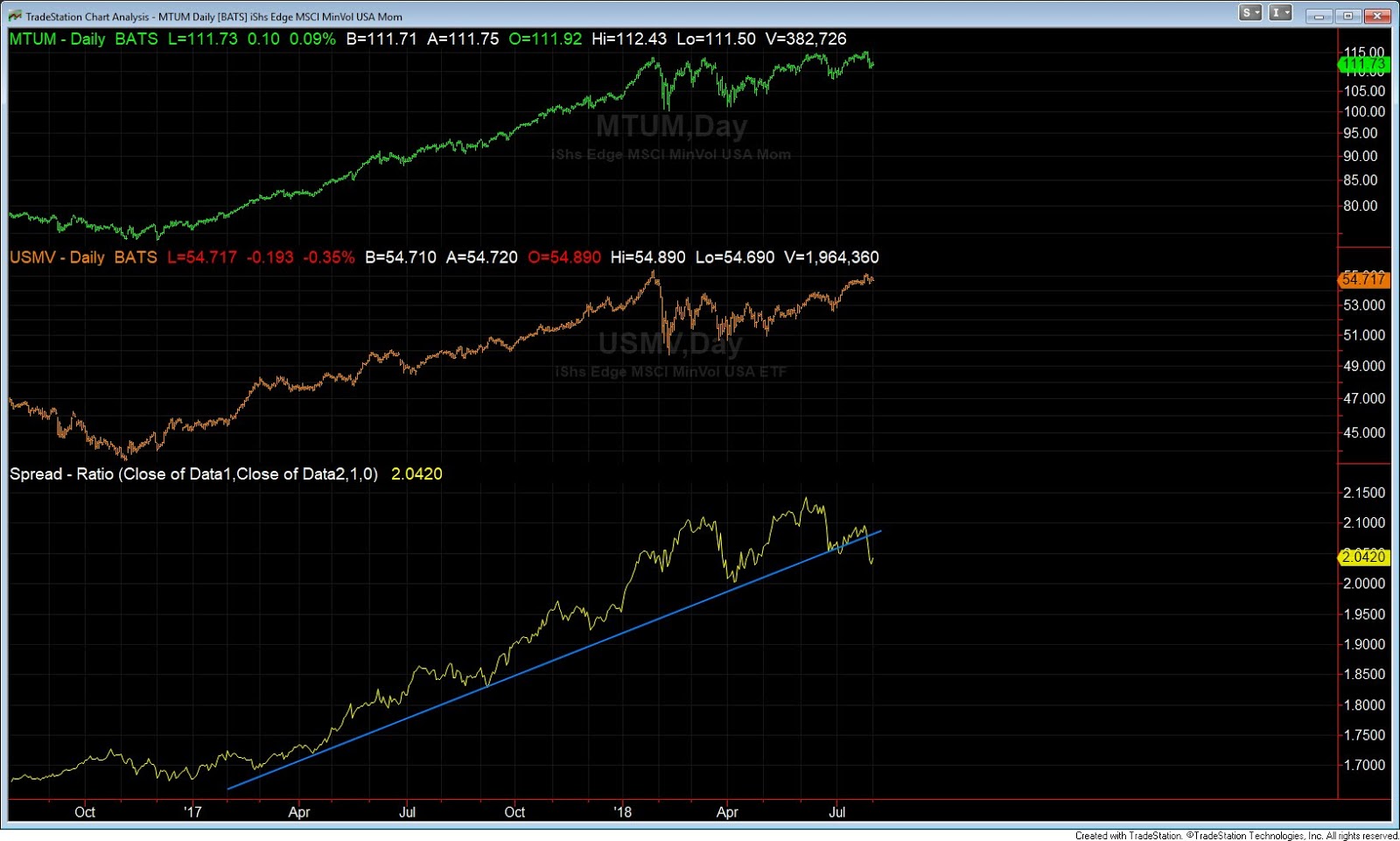
The momentum trade started to breakdown the last few days of July.  Lets look at some ratio charts to possibly confirm rotation into more defensive names.  The first two charts compare momentum to low volatility.  Both are breaking down below their lower trend line support.  The last chart is a ratio of consumer discretionary to staples.  What all three have in common is that lower volatile and more defensive names are outperforming recently.  Does this confirm the trend has changed?  The evidence is not resounding enough just yet to substantiate this rotation.  Yet, this is something we'll closely monitor as we enter August. 


The bull market in equities continues with most indices at new monthly closing highs or very close.  We touched on breadth in our last post and with the recent breakdown in momentum stocks we could be in for some short term pain.  Couple that with the weak seasonality of August and September could set the stage for better entry levels lower before the bull resumes higher. 

Tuesday, May 1, 2018

Sell in May and Go Away - Really??

Most market observers have heard the old adage "Sell in May and Go Away".  As with all statistical analysis you have to look deeper into the data and not take it at face value.  While it is true the next 6-month stretch is the worst for the S&P going back to 1950 (1.59%) not all is negative.  Five of the last six years saw a positive May through October posting an average gain of 4.8%.  Also if you take into context where the long term trend of the S&P resides the data tells a different story.   If the S&P is trading above the 10-month moving average, the May-Oct time frame still shows the weakest 6-month return however it boasts a gain of 2.45% and positive roughly 70% of the time.  On the flip side, if the S&P is trading below the 10-month moving average the average loss is -2.04% and only up close to 50% of the time, which ranks second worst in performance only behind April-Sept. 


 Looking at May data:
  • Last 20 years: May ranks 7th in monthly performance with an average gain of 0.05%
  • Last 20 years: The average daily trend is trend-less swinging back and forth
  • Last 20 years: May is the second least volatile month
  • Since 1950: May ranks 8th in monthly performance with an average gain of 0.24%
  • Since 1950:  May is higher almost 60% of the time and ranks 8th in volatility


Given the state of the current environment featuring higher volatility and choppy waters we don't want to totally ignore the seasonality statistics.  We are more concerned with the overall trend in the market.  However, with the S&P barely above the 200 day coupled with a declining 50 day moving average we are willing to be patient in this market.  If the S&P can rally and stay above an upward sloping 200 day moving average the old adage of sell in May and go away may prove worthless. 

Wednesday, January 31, 2018

A blistering start to the year. Now what?

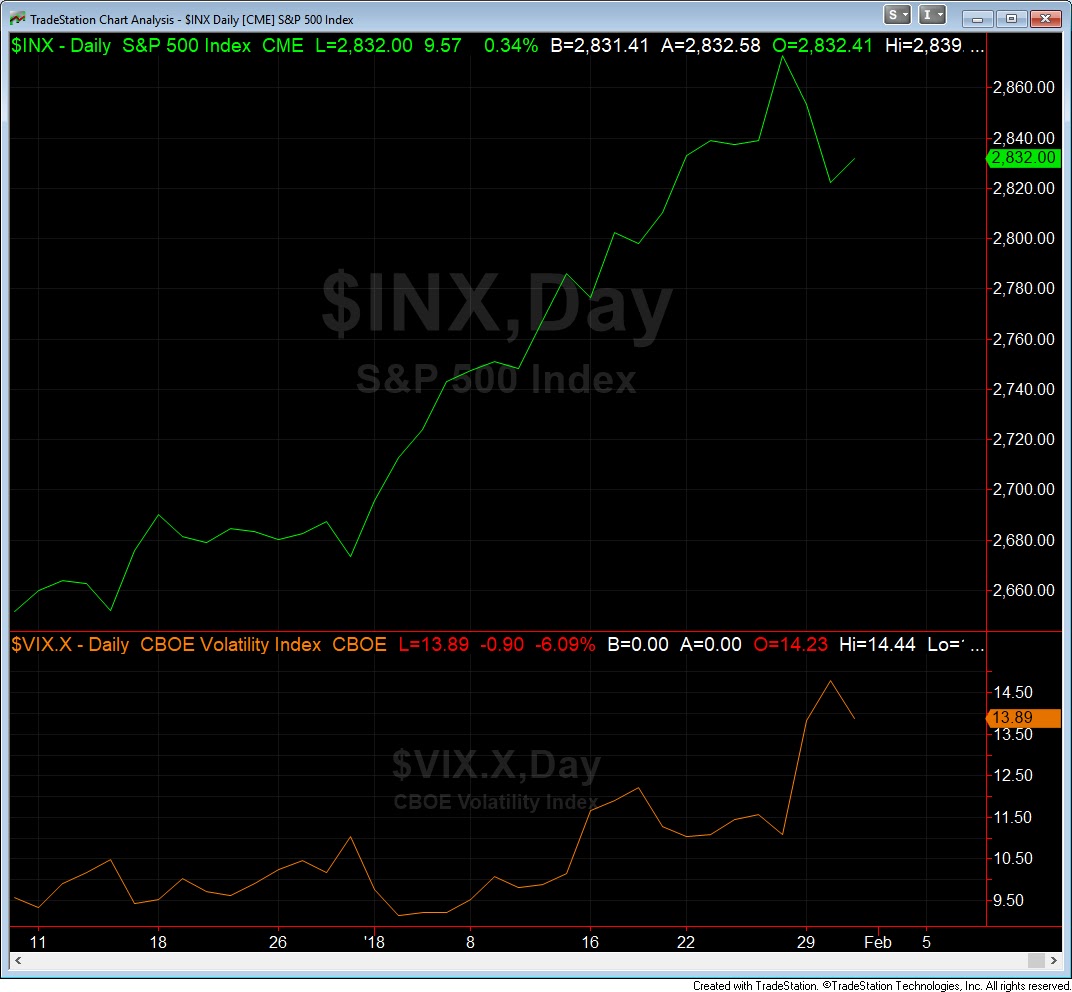
Global and domestic equities have started off 2018 on a blistering pace to the upside continuing the strong uptrend from 2017.   The idea that the new year would usher in tax selling after big gains last year couldn't be more opposite.  Instead, it seems as if money has poured into equity funds in a fear of missing out trade.  This market is being labeled a melt up market and frothy.  While short term indicators show that US equities are overbought we continue to think that the secular bull market remains the dominant trend and there is plenty more to come.  However, that doesn't mean we should not expect heightened volatility and periods of shakeouts and draw-downs.  We assume they will occur and the move in volatility this month is a testament to that theory.  In fact, this January hit another new record as it was the first time that the S&P 500 and the VIX both hit a new 10 day high at the same time. Below looks at how the VIX and S&P have become more correlated and trended higher throughout January.  

Lets take a look at the February Data:
  • Last 20 years: February ranks eighth in monthly performance with an average loss of 0.02%
  • Last 20 years: The average daily trend is choppy and trend-less
  • Last 20 years: February is the forth most volatile month 
  • Since 1950: February ranks ninth in monthly performance with an average gain of 0.10%
  • Since 1950:  February is the 9th most volatile month and is higher 56% of the time
  • Since 1950:  January is tied with July with the most 5% or greater monthly gains


We want to see what the S&P did for February, full year, and the rest of the year after gaining more than 5% in January.  The sample size is small with only 12 prior instances going back to 1950 but still paints a rosy picture for 2018.  We took it a step further in the second study looking for prior instances of a 5% or greater January and the prior month hit a new high  Even smaller sample size but still remains bullish.  


One of the main reasons driving this bull market is that we are going from a QE market to an earnings driven market.  This is the first time in a while that earnings revisions are actually be raised rather then revised downward throughout the year (from NDR). 


There is a legitimate concern about the rise in rates and rightfully so.  However, we looked at the data when the S&P was up more than 5% and the TNX (10 yr yields) are up greater than 10% just like this January and we find that the returns in the S&P remain favorable to the bulls going out 1,2,3, and 6 months.  Are the rise in rates signaling a better economy?  We think so, and also believe that rates will have to be much higher before they become a big problem.  There was only one prior instance of January gaining more than 5% and TNX gaining more than 10%.  That was in January 2013. 


The 3 major averages all broke their steep up trend-line from the January lows on Tuesday.  This simple 1% down day, which was the first one in 112 days, caused traders to panic and it seems as if sentiment went from overly optimistic to extremely bearish in one day.   The CNN fear and greed index sits at 61 as it pulls back from extreme greed at the same time the put call ratio spiked along with the VIX.  Yet, the S&P broke the record for number of days without a 5% correction this month.  The US equity markets have started the year off on a hot start.  We don't expect the same bullishness every month this year but the stats favor another strong year.  Even though we remain bullish longer term we expect bouts of volatility to increase throughout the year and having a tactical view will prove to be prudent. 

Friday, December 22, 2017

2018 Market Prediction

With the New Year rapidly approaching we are starting to see a flurry of market predictions for the 2018.  After extremely healthy returns across the global landscape in 2017 it is no coincidence that most prognosticators are bullish heading into next year.  As much fun as making predictions are, we also know that most are a waste of time and useless.  You only have to look at recent history of how awful these year end calls end up.  Nevertheless, most investors like seeing and hearing positive projections.  We prefer to gauge the current market temperature by analyzing various data points which help shape our bias in the short, intermediate, and longer term.  We study indicators including fundamentals, sentiment, volatility, and technicals.  One of the better blogs out there is from Urban Carmel at the Fat Pitch.  His recent blog takes a peek at 2018 and touches on a few of the data points we also watch.  I recommend reading the whole piece but I wanted to highlight one that stood out to us.  Most pundits will use past data to shape their future outlook.   However as we see from Urban's blog, prior years returns have no bearing on what stocks will return the following year.

"Data over the past 120 years shows that whatever happens in one year has very little impact on returns or probabilities the following year. If stocks gain over 20% this year, their return next year is not much different than if the market had fallen this year (right column). Moreover, the odds of stocks rising next year is the same regardless (second chart; both from Mark Hulbert)."


If we turn our attention to the monthly BAML global fund manager survey we can get a better idea of current sentiment and bias in the world markets.  Below is a recap of the December survey.

December FMS takeaways
  • Icarus loves Cash: Dec FMS shows investors raising cash to 4.7% from 4.4% despite surging credit & stock markets, paving way we think for more risk asset upside in Q1.  BofAML Bull & Bear indicator @ 6.2 is not excessively bullish, consistent with further Icarus trade upside. When asked when equity markets will peak, 25% of investors sayQ1’2018, 30% say Q2, 28% say H2.
  • Golditrumps: consensus still smitten by Goldilocks...54% expect “high growth, low inflation” in 2018. Almost 2/3 investors believe US tax reform will induce higher stocks& rates, but fiscal stimulus has coincided with lower, not higher profit expectations, and that will need to change given EPS leads relative performance of cyclicals by 3 month(Exhibit 10).
  • Pro-cyclical Consensus: Investors are long macro “boom”, short “bust”; long stocks,EU/Japan/EM stocks, financials (2nd largest ever), materials (highest since 2/2012) vs short government bonds, US stocks, healthcare & utilities. Pro-cyclical consensus entrenched by US tax reform across asset classes, bar, intriguingly, leading tech sector where allocations dropped to lowest since June 2014 (Exhibit 4).
  • FMS Crowded Trades: ...#1 long Bitcoin (32%), #2 long FAANG+BAT (29%), #3 short volatility (14%), while expectations for a “flatter yield curve” surged (highest in 18months), all trades vulnerable to higher inflation & aggressive ECB/BoJ Quantitative Tightening in 2018.
  • Contrarian Recession Trades: ...a recessionary bust even more contrarian than inflationary boom, lower rates more contrarian than higher rates, making short equities long bonds, short banks-long utilities, short EAFE-long US stocks the most contrarian trades of all heading into the new year.
We believe the strong returns of 2017 was due to multiple factors, however the growth of global economies and therefore earnings was the main driver of success.  This reveals itself in the survey as 54% of managers expect high growth and low inflation in 2018.  This is one of the main arguments for a bullish 2018.  A stable and growing economy coupled with US tax reform that could turbo charge earnings is what has us most excited for next year.  Before we get ahead of ourselves we need to recognize that some of this has been priced in the current markets.  As global markets sit at or near new highs it is interesting that the percentage of fund managers saying equities are overvalued is at multi-decade highs.  You would have to go back to the late 90's to find similar readings.  Meanwhile allocation to tech stocks falls to a 3 1/2 year low.  It seems managers are taking some profits after a huge run in tech related stocks.  Yet this could act as a contrarian buy signal for next year for this sector.  FMS cash rose to 4.7% reflecting a neutral stance among investors as cash levels are not near excessive overheated levels.  With cyrto-currencies the hot buzz word this holiday season it is no surprise that the most crowded trade is long Bitcoin.  With US tax reform passing Congress, two thirds of managers expect tax reform to result in higher bond yields and higher stocks while only 3% think it will lead to lower yields and stocks.  Lastly, allocation to US equities rises to net 15% underweight as Eurozone falls to net 45% overweight, but remains elevated versus history at 1.1 stdev above its long-term average.
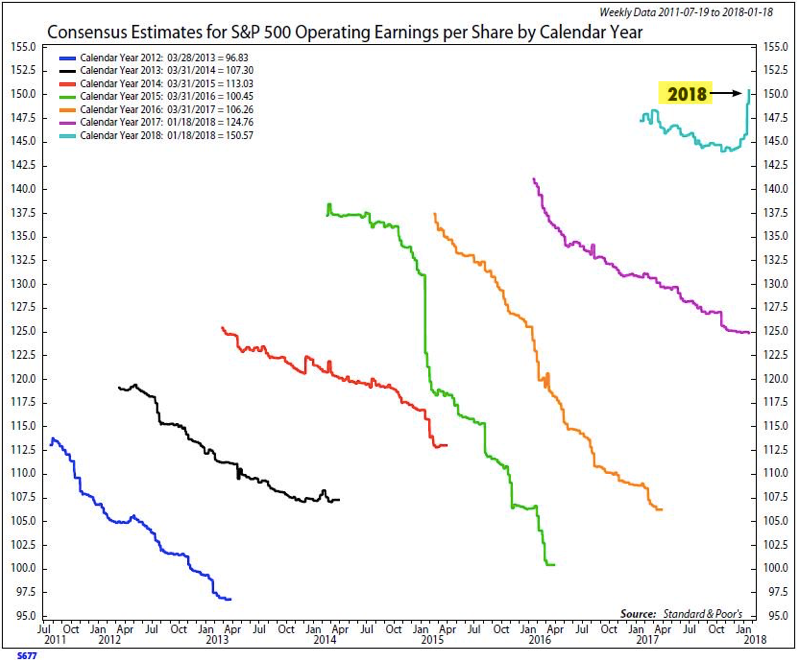


In conclusion, we remain firmly in the secular bull market camp.  Yet, we also know from historical norms that the average intra-year drawdown is 14% in the S&P.  2017 was clearly an anomaly with regards to volatility as the biggest drawdown was a measly 2.9% and the last 5% drawdown occurred almost two years ago.  We expect a bigger drawdown at some point in 2018 coincided with a rise in volatility.  Regardless, we don't think it will derail the bull market and should be used as a buying opportunity as US equities remain underweight.  One of the biggest reasons we think predictions are so silly is the global markets are so dynamic as information changes rapidly.  At any given moment a new catalyst can reshape our thesis, however as we stand today the investing landscape looks promising into 2018 with the potential for an upside kicker in US markets based on tax reform.

We want to wish everyone a happy and safe holidays and look forward to what 2018 holds!